Showing posts with label jewish quarter. Show all posts

Wednesday, 19 September 2018

The Cardo

The Cardo is the main North South Str. of all important towns in the Roman Empire. For example you can find a Cardo in Caesarea, the capitol of Judea in Roman times, Sebastia, the capital city of Samaria, Bet Shean, one of the Roman cities known as Decapolis cities, located in the Jordan Valley, Hippos, on the shores of the sea of Galilee, another Decapolis city, Migdal (Magdala), Arbel, Sepporis and so on.

Most of these Cardo’s date from the time of the emperor Justinian in the 6th century, during which time Christianity was at the peak of its power and wealth in the Roman World, although Cardo’s existed in the Roman world long before Justinian.

All of the cities mentioned above also have magnificent churches, or at least the ruins of these churches. For example it is reputed that there were over 200 churches in Jerusalem alone. To name a few: the church of the Ascension on the Mt. of Olives, the church of Dominus Flevit, the church of the agony in the Garden of Gethsemane, the Nea church and of course the church of the Holy Sepulchre and many others.

The Cardo in all these cities is distinguished by rows of columns on either side of a broad street. The columns supported a roof, usually made of red tiles which gave shelter to the citizens on the sidewalk below. Usually there were shops on the sidewalks.

Naturally markets were held on these sidewalks, but that was not the purpose for which they were built. They were built for spectators, who would be the citizens of a city, who would be required to witness daily parades. Each day celebrated feasts of a national, patriotic nature, such as the Emperor’s birthday, or the birthday of one of the saints, (in Pagan times, before the advent of Christianity, the birthdays of the gods, Jupiter, Saturn etc.)

On holy days the saints would march solemnly down the road, accompanied by singers and bell ringers, all colorfully dressed.

The Cardo always connected between two churches (temples in pagan times) so that the procession would proceed from one church to the other. It was especially used by pilgrims on their visits to the holy places, like marching with the cross, as Jesus had done, along the road to Calvary.

Probably the crowd would also be required to stand at the side of the road as a convicted person was being lead to the place of execution. This way the citizens could witness the pursuit of Justice for which the Roman Empire prided itself. Justinian himself was known as the lawgiver.

The Cardo in Jerusalem extends from the Zion Gate, near which are the ruins of the Nea church, the biggest church in the world at that time, to the Damascus Gate, in Roman times the Northern Gate of the city, built by the emperor Hadrian when he built Aelia Capitolina, a city built to the North of the city of Jerusalem which lay in ruins in his day.

He probably built the first Cardo as a procession road leading from the entrance of the city to the temple of Aphrodite along one street and the temple of Jupiter along another.

Constantine the great in the 4th century changed the temple of Aphrodite into the church of the Anastasia or the resurrection, to commemorate the resurrection of Jesus from the dead, today known as the church of the holy sepulcher. In his day the Cardo lead from the northern gate to the church.
Justinian extended the Cardo to reach his new church, the Nea.

The Herodian Quarter

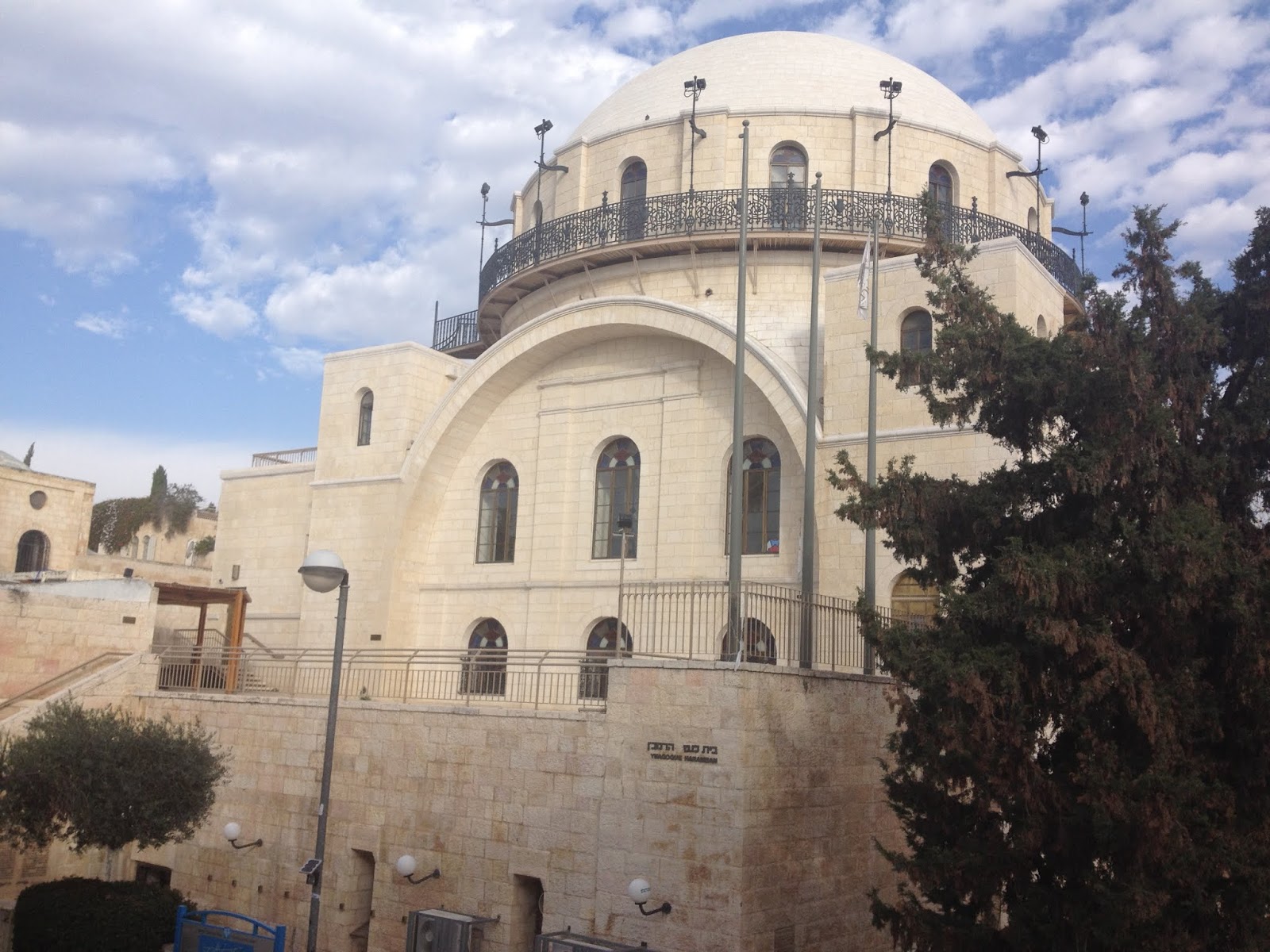
The Herodian Quarter lies buried beneath the magnificent new structure of the Yeshiva of the Kotel, so named because of the view of the Wailing Wall (Kotel in Hebrew) which one has from its roof.

The builders of the Yeshiva of the Kotel, in 1985, didn’t deliberately build it on top of the ruins of this neighborhood of luxury houses dating from the time of Herod the Great in 40 years before the Christian Era.

In fact they only built this new building because the Jordanians had destroyed the previous building, built in the 19th century, during their rule of Jerusalem after the war of independence in 1948 until 1967 when the Jews had conquered the Old City of Jerusalem, and began re-inhabiting it.

The builders, while digging foundations for the new Yeshiva uncovered this beautiful neighborhood, with 6 roomed, 3 level palatial residences.

The neighborhood, which was so new in the days of Herod the Great had laid buried in ruins after the Roman destruction of Jerusalem during the great rebellion of the year 70, until this accidental discovery.

These houses are obviously part of a luxury neighborhood, described by Josephus Flavius, in his book, the Antiquities of the Jews, written nearly 2000 years ago, as a new suburb built by Herod the Great for the priestly families, appointed by Rome.

These included the high priest Caiphas, mentioned in Christian scriptures, appointed by Valerius Gratus, the procurator who preceded Pontius Pilate.

The houses were equipped with water cisterns to ensure a reliable supply of water. The floors were decorated with beautiful mosaics, with geometric designs, not infringing on the law forbidding graven images of people, plants or animals, which one could see in Roman houses of the period in Rome, but not in Jewish homes.

The walls were covered with plaster painted over with frescos. The furniture, glass, and pottery bowls lay strewn on the floor.

Some of the utensils on exhibition were carved out of limestone, a sign that they were meant to be used by the priests, because they did not contaminate in the event of a person dying in one of the rooms. In such an event all pottery would be destroyed, being considered unclean. This was because entrance to the temple was permitted only to priests who were ritually pure. Death caused defilement and any utensil, excepting a stone utensil would become contagious.

Several fine, glass jars, made by the famous Roman glassmaker, Enion of Sidon were found; his insignia appears on the side of the jar.

The houses had many ritual baths, also indicating that the inhabitants of these houses were priests, who used the baths daily for ritual cleansing.

After visiting Jerusalem, seeing these archaeological remains, Herod’s Palace under David’s Tower, remains of the outer Western Wall of the courtyard of the temple and now the 6 Herodian Houses. and reading Josephus’ descriptions we can be quite sure that Jerusalem was no mean, rustic village, but one of the most beautiful cities on earth, the likes of which have vanished never to be seen again.